

What Your Hands Know
Our original digital devices and an embodied writing practice from my upcoming book(!)

Thanks for reading! A few upcoming events:
The Field of Attention: January 5th - February 9th & March 2nd - March 30th in Portland, Maine. A two-part series to explore attention through embodiment and writing. Session I is sold out, but you’re welcome to join the waitlist here by selecting Session I. A few spaces remain in Session II!
Tuscany Retreat: May 1st - May 6th, 2026. Guided by beloved local hosts and friend/yoga teacher Bri Gallo, we’ll return to Tuscany for yoga, embodied writing, delicious food, and local delights. This retreat is pure joy. Join us!
“This now is it. This. Your deepest need and desire is satisfied by the moment’s energy here in your hand.” – Rumi
I learned how to knit from a friend’s patient grandmother in the third grade. This friend was also named Johanna (relegating me, for the entirety of elementary and middle school, to the designation Johanna F) and so we two Johannas sat on the porch, laboring over this knitting thing. You might picture me in a little bowl cut, brow furrowed in concentration, trying to get the yarn and needle to come together into what I hoped would become a scarf for my hamster, as one does.
The “scarf” was only two inches across, but since I couldn’t figure out what to do once I’d made my way to the end of the row, every eight messy, misshapen stitches, I walked over to Johanna’s grandmother for help. Help which involved simply turning the thing over to begin again.
I didn’t know what I was doing with that tangled yarn, but I discovered something that day that has buoyed me since: the potency of making by hand. And the corollaries that come along with it: to turn towards elders for instruction, that hands know in ways the mind cannot, that pieces can be braided and twisted and made into something sustaining and beautiful (ok, well not in this particular case).
I’ve been thinking about this quiet revelation in the months since I handed in the manuscript for my book. Maybe because I haven’t been able to do much writing (I get the irony - you’re reading this!) and instead find myself picking up projects that ask for making more than thinking. Projects that ask for hands.
A pillow for a friend’s birthday. A quilt for the back of the couch. Little woven patches on my torn sweater. A Swedish princess cake for my Swedish mother’s birthday - an hours-long process involving food coloring and custard and cake and shaping roses out of marzipan.


None of it special or singular or even skilled. But offering a kind of ground. Because while my attention is on the project in front of me, it’s also echoing across generations. To my mother who sewed our nightgowns and knit our sweaters (also cut our hair, hence the bowl cut…), to the intricate dollhouse furniture my great great aunt built for the Swedish royal family, to my daughter’s elaborate replicas of the places she loves.
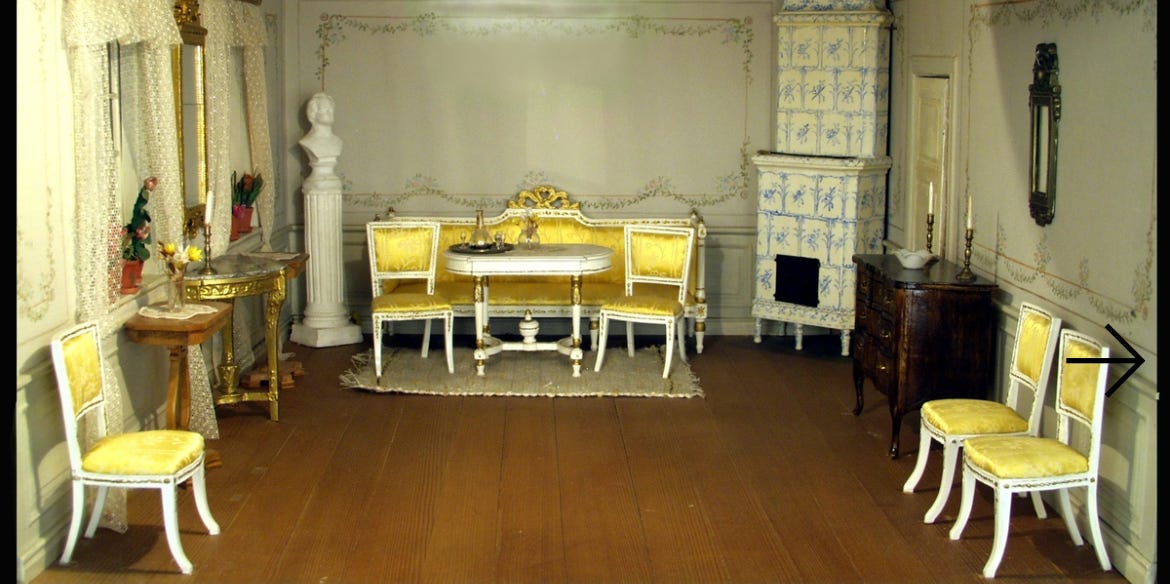
We all have this. Wherever you are, whatever you do, someone earlier along your line was preoccupied with making: food or shelter or clothing or music. There’s nothing fancy or bespoke about this, and most folks who work with their hands (like my carpenter husband) aren’t lost in some reverie of lineage. They’re simply working.
Before doomscrolling existed, before we knew to collapse our bodies while our fingers numbly tapped, we were intimate with these, our original digital devices. The ones that deliver babies and paintings and casseroles, that bring into being. Even the word manifest has hand hiding right there at the front in the Latin manus, reminding us that it all begins in our hands (which you’ll also find in manuscript - writing begins with hands too, and it’s one of the reasons our embodied writing workshops encourage pen on paper; we want to move at the body’s pace, where the truth can be worked out in real time).
Years as a bodyworker deepened my understanding of the particular intelligence that lives in our hands. When I listen from here, I uncover information my strategizing mind could never have found. You’ve maybe had this experience too, when you reached for something or touched something or rested somewhere and discovered material your mind could only make sense of later.
The mind may be crafty, but the hands know craft. From Cræft/Kraft: power and strength.
And now especially, when the world feels entirely spun out, when it isn’t clear what we can do to stop the terrible onslaught, our hands offer a felt sense of what is possible.
Knitting a hamster scarf did not fix the world. It didn’t undo injustice or rebalance power. But it showed me, in a bodied way, what our hands create and the potency of our messy, awkward, human making.
For inspiring Substack handcraft see Lia Pas, Wendy MacNaughton, and Emma Webb.
If you’d like to practice moving your awareness into your hands, here’s an embodied writing practice drawn straight from my book - coming from North Atlantic Books in August 2026!
Practice: Hands
Pause for a moment and bring your awareness into your hands. Are they resting, doodling, holding the pages of a book? And how about what they’re feeling? The texture of paper? The warmth of a teacup? We use our hands so often and for so much that we can miss their supreme capaciousness. They both do and feel.
If you’ve taken an anatomy and physiology class you’ve likely seen the illustration of the “cortical homunculus,” a little man (only recently have models of women been developed) drawn so that the areas of his body are proportionate to the number of his sensory nerves. Which means that his back and legs are tiny, while his lips and hands, richer in sensory nerves than most other areas of the body, are enormous. You can see this in practice: Trace one gentle finger along your palm and you’ll feel even the slightest sensation. The hands aren’t only sensitive; they’re also strong. That very same hand can become a powerful vise if, say, the salsa jar lid is on too tight.
In this way, the hands are uniquely gifted vocalists in the chorus of the body’s parts. They have range. Not only strength and sensitivity, but open and closed, tight and soft, giving and receiving. As we move into direct work with hands, part of our invitation is to keep our attention actually in our hands. Notice the textures beneath your fingers and the things you love to hold, maybe a warm stone, flower petal, beach sand. Notice what you love to touch or be touched by. What do your hands tell you? What do they know?
The hands invite us to move into a rich series of somatic inquiries which might include: What am I reaching for / what am I releasing? What am I opening or closing? How do I build, make manifest, and realize my dreams? What do I love to touch? What do I love to be touched by?
Engage the body
See if you can locate a small, tennis-sized ball (a rolled up pair of socks will do in a pinch). Then, begin by massaging the hands: press into the palms, grasp and release each finger, bring in a bit of gentle traction at the knuckle joints.
Next, using your ball on a table surface, slowly roll it around the palms, pausing & leaning into spots that feel stuck.
To close, rub palms together quickly, generating heat, and rest them on your heart/chest. Pause for a moment in appreciation of your hands. Consider what you’ve chopped, stirred, stroked, petted, made, soothed, punched, scratched, braided, baked, swept, pushed, folded, torn, planted, broken, mended.
Write
I fill my hands with / I empty my hands of…
Feel free to share your writing below!